


When I was in college I went through what felt like purgatory, but for the sake of this post we’ll call it what it actually was: switching majors.
I’d been led astray by movies like Dead Poet’s Society and Finding Forrester, romanticizing my ill-guided decision to enter Cal State Fullerton as an English major. But two semesters in, this protagonist lost the plot. I wasn’t just unclear, I was officially undeclared.
I dabbled in things that interested me like anthropology and philosophy (clearly doubling down on my cinematic influences), but outside of being mildly interesting at parties, I had a hard time envisioning practical use cases beyond college.
My advisors, professors, and parents all repeated the holy trinity of advice for the lost college kid: “follow your passions,” (which I didn’t know), “network,” (which I hated) and “talk to mentors,” (which I had none).
I remember thinking, “I wish I could just talk to people with cool jobs and see if they like it.” And then I realized something that would change the trajectory of my career journey forever… I could.
Enter: the informational interview.
Mind you, this task was harder to do twenty-two years ago… but I set my sights on one person who, by all accounts to a 20-year-old, former english major, from Orange County, had the “dream job.” Mr. Tim Mead. The Vice President of Communications for the (Anaheim) Angels. LinkedIn, apparently, was invented already (2003), but nobody had ever heard of it, so I was left to my own sleuthing skills. I sent over 20 different emails, every permutation I could think of… tim@angelsbaseball.com, tmead@angelsbaseball.com, tim.mead@angelsbaseball.com, and so on.
And, what do you know, It worked.
For the next two months, Tim and I would play phone tag trying to align our schedules. His calendar was a bit more full. Not by much, mind you, Joes Crab Shack ran a pretty tight ship. But, eventually, we got it on the books.
I remember walking down the hallway of Angel Stadium’s front office. Picture after picture after picture of baseball royalty. These legends I watched my entire childhood guiding me to the promise land (Tim’s office) for a 37-minute informational interview that would forever change the trajectory of my career journey.
That was my first informational interview, and certainly not my last. I still do them to this day (just with less email guessing), and I think they are the #1 most underutilized and underappreciated tactics in career and network discovery.
Here’s what I’ve learned along they way…
What Is an Informational Interview (and Why It’s Your Secret Weapon)
An informational interview is a 15-30 minute conversation, virtual or in person, where you learn about someone’s career path, industry insights, job details and/or company culture.
Unlike job interviews, you’re not asking for a position, you’re asking for knowledge. Read that part again because it’s what a majority of people get wrong. The best informational interviews come from a place of curiosity NOT with the expectation to get hired.
You’re planting a seed. You wouldn’t expect it to bloom immediately, you have to follow the care instructions:
Planting the Seed
Finding the Right People
You can reach out to anyone in any job at any time. Literally.
Think of the jobs or companies that interest and inspire you. Use LinkedIn like you use Google. If an ideal company is Ulta Beauty, and you’re interested in influencer marketing, search: “Ulta Beauty” AND “influencer marketing.”
Be sure to select “People” and mark “Current Company” to Ulta.
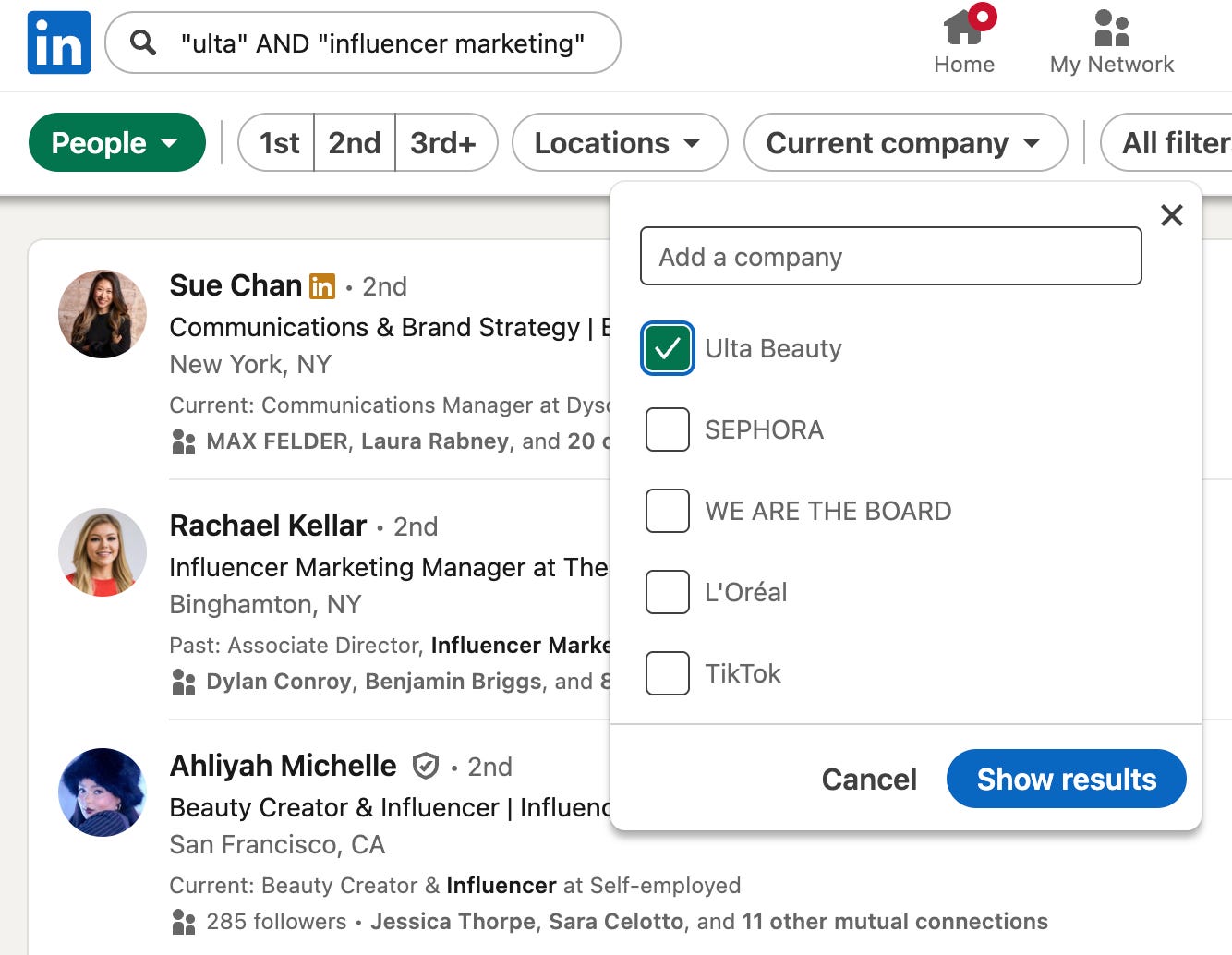
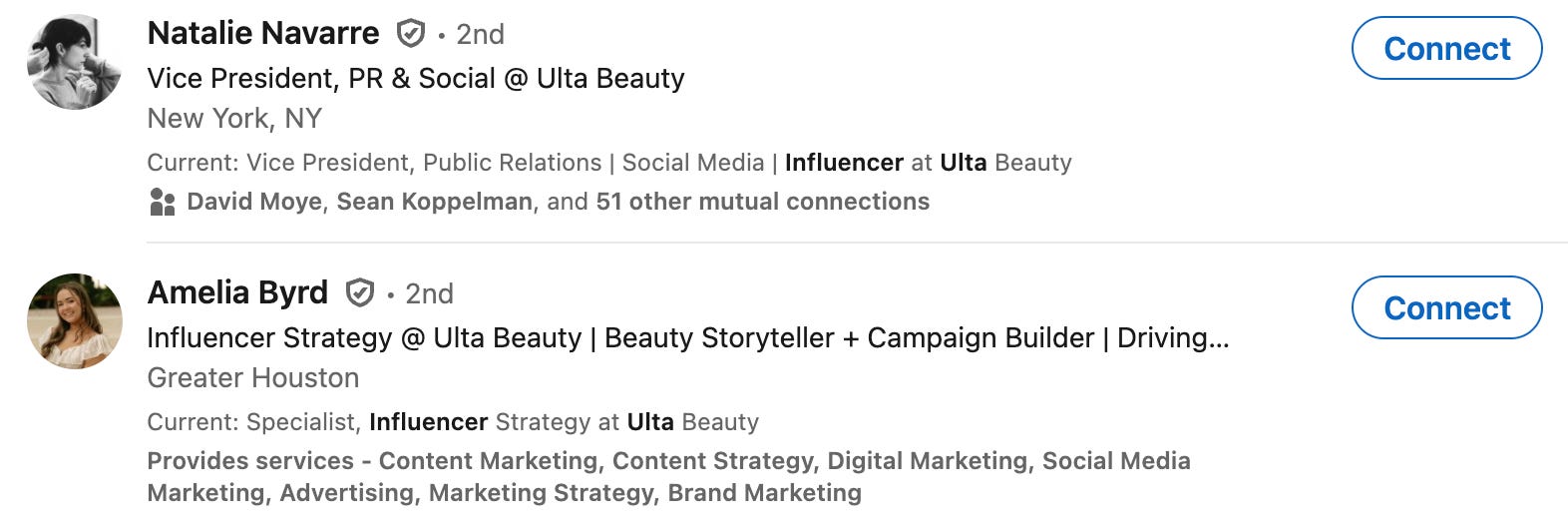
Sure enough, you will find who works in influencer marketing for Ulta Beauty.
The Outreach
The results will give you several options. To “connect” or to “follow” — make sure you connect. If connect does not show up as an option, you have to go to their profile and select it from the “more” button.
When you submit a connection request, you have the option to provide a “note” or “send request without a note.” Depending on your LinkedIn account, you may be limited to number of connects with notes. If you can send a note, I’d recommend it. A LinkedIn connection note has a 300-character limit for Premium users and a 200-character limit for free users.
